Why Every Modern Website Needs an Interactive Calculator
A modern website isn’t just a digital brochure – it’s an active participant in your customer’s decision-making process. Visitors no longer want to read endless paragraphs or fill out generic forms. They expect tools that answer their questions instantly. That’s where interactive calculators come in.
An interactive calculator turns static content into a personalized experience. Instead of passively consuming information, users can input their own data – whether it’s budget, project scope, or desired outcomes – and see results that matter to them in real time. This immediate feedback creates trust and engagement that no traditional call-to-action can match.
Think about how users behave today. When planning a purchase or project, they want to know before they buy. How much will it cost? How much will they save? What’s the best option for their needs?
A calculator answers all those questions on the spot – and it does so interactively, without making visitors leave the page or talk to sales first.
For businesses, this is gold. Interactive tools collect qualified leads naturally, because users willingly share relevant data in exchange for value. A single price estimator, ROI calculator or savings tool can transform your website from a marketing channel into a conversion engine.
According to 2026 data from the Demand Gen Report, 91% of B2B buyers now prefer interactive content over static formats. Interactive lead magnets like calculators and quizzes convert 2.4× higher than static PDF downloads, and brands deploying them report a 78% average lift in lead capture rates. A separate Content Marketing Institute study found that interactive content generates roughly twice the engagement of passive content. Why? Because these tools create a dialogue, not a pitch.
For designers, marketers, and developers, this means that building calculators isn’t just about functionality – it’s about shaping how your brand communicates with its audience. A well-designed calculator reflects transparency, confidence and a willingness to help, which are all key to trust-based marketing.
Top 3 Best Interactive Calculator Builders for 2026
You don’t need a coding team or a complex backend to add a calculator to your website. Today’s visual builders let anyone create one in minutes. Here are the top 3 tools we recommend based on usability, design flexibility, and marketing potential.
Our mini-ranking is based on a more extensive study by Howard Steele published on SuperbWebsiteBuilders.com

uCalc is one of the most intuitive calculator builders available today. It’s designed for speed and simplicity, allowing anyone – from small business owners to professional web designers – to create a fully functional calculator in minutes. The platform’s drag-and-drop interface lets you combine elements like sliders, dropdowns, checkboxes and text fields without touching a single line of code.
But what truly makes uCalc stand out is how easily it fits into any workflow. You can connect your calculator to email services, CRMs or messengers to automatically send collected leads, integrate with Google Analytics for tracking and even accept online payments via PayPal. Note: as of 2026, PayPal is the primary payment integration — Stripe is not natively supported; for Stripe payments, consider ConvertCalculator as an alternative. Once ready, your calculator can be embedded anywhere – on Wix, WordPress, Squarespace, Webflow or even plain HTML sites – using a simple copy-paste code.
uCalc also comes with an impressive library of ready-made templates for every use case imaginable:
- pricing estimators for service businesses,
- product configurators for e-commerce,
- mortgage or ROI calculators for finance,
- appointment or booking forms for salons and studios.
Each template is fully customizable – from colors and fonts to field logic – so your calculator matches your brand design perfectly. Advanced users can unlock conditional logic, real-time total calculations and multi-step forms that guide users toward a purchase decision. The formula editor supports nested conditions, variable references, and multi-formula chains — users report building calculators with 15+ conditions without performance issues.
And because everything is cloud-based, you don’t have to worry about hosting or performance – uCalc calculators load instantly and look great on mobile devices. Paid plans start at $9.99/month; a free plan is available with limited features.
Best for: Small businesses, agencies, and creative studios that want a professional, conversion-ready calculator live within minutes – not days.
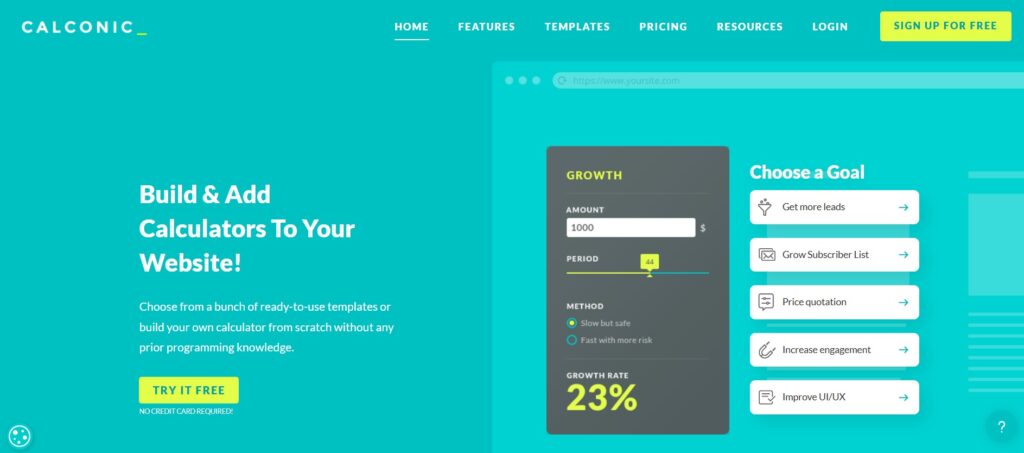
CALCONIC is built for designers who care about aesthetics just as much as functionality. It’s known for pixel-perfect integration – your calculator doesn’t just work well; it looks like part of your website. The platform’s editor focuses on layout precision, spacing, and typography, which makes it ideal for brands with strict visual standards.
Every element can be styled down to details like border radius, shadow, or gradient overlays. This means your pricing or ROI calculator won’t feel like a widget — it will look like a native component of your design system.
CALCONIC also supports multi-step user flows, conditional visibility, and advanced math formulas, making it suitable for both creative and technical use cases. You can calculate project costs, generate quotes, or even build donation trackers and savings tools.
Its embedding process is straightforward – just paste the generated code into your CMS or builder. There are three embed options: standard embed, popup, and iFrame — all adaptable to any site width. The calculator adapts automatically to your site’s width and color scheme, maintaining design consistency.
For marketers, CALCONIC offers data submission and integration with email tools, so users’ inputs can be captured for follow-up. It integrates with Zapier (connecting to 1,000+ apps), supports PayPal and Stripe payments, and includes a 14-day free trial. Paid plans start at $6/month (billed quarterly). A free-forever plan is also available with 500 impressions/month — useful for testing or low-traffic sites.
Best for: Designers and studios that prioritize brand aesthetics and want a calculator that merges seamlessly with their site’s look and feel. Also a strong choice if you need a free starting tier or Stripe payment support.
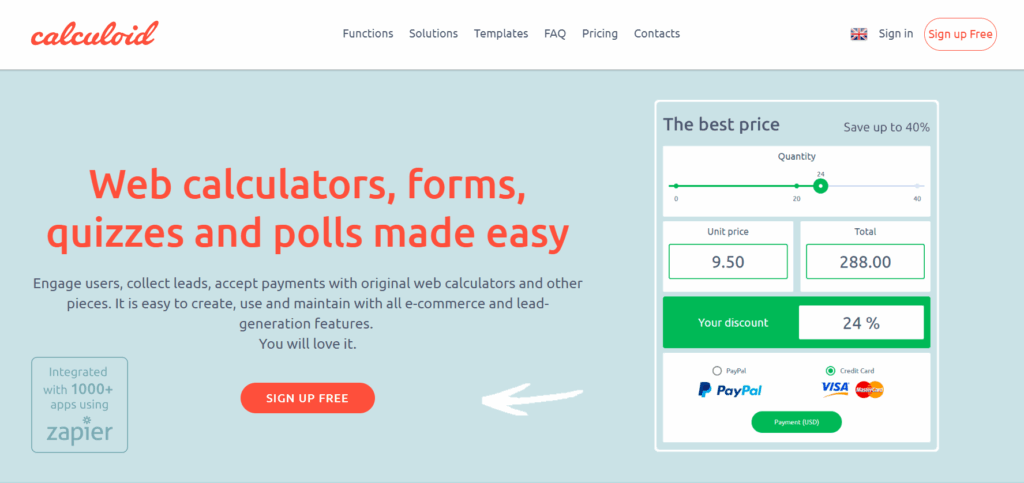
Calculoid takes a slightly different path – it’s the powerhouse of the group. Built originally for enterprise and SaaS environments, it focuses on data accuracy, scalability and automation. The interface may feel more technical, but that’s the tradeoff for its unmatched logical depth.
With Calculoid, you can build calculators that handle complex business formulas, multi-variable dependencies, and even real-time database connections. The platform also boasts a library of 4,000+ public calculators you can copy and adapt. It’s perfect for use cases like:
- ROI and performance forecasting tools,
- subscription and SaaS pricing engines,
- loan or insurance calculators,
- internal cost management dashboards.
One of its strongest features is integration. Calculoid connects with Google Sheets, HubSpot and Zapier, allowing you to automate data collection and analysis. Payments are supported via PayPal and Stripe (available on e-commerce plans). You can use calculators not only for lead generation but also as operational tools that help your team make data-driven decisions.
The platform also includes user accounts, data export, and custom branding, which makes it ideal for embedding into client portals or internal apps. While it offers less visual polish than CALCONIC, its technical depth is unmatched. One recurring user complaint is that the interface feels somewhat dated and can be slower to load. CSS customization is available for advanced users who need mobile-responsive styling.
Best for: Companies and SaaS teams that need complex logic, integrations, and reliable data processing. Especially useful for teams that want to copy from an existing library of 4,000+ ready-made calculators.
Choosing the Right Tool
Each platform fits a different workflow:
- uCalc – for instant setup and lead capture. Paid from $9.99/mo; best for multiple calculators across different service types.
- CALCONIC – for design perfection and brand integration. Free plan available (500 impressions/mo); paid from $6/mo. Best for design-driven brands; supports Stripe.
- Calculoid – for data logic and enterprise automation. 4,000+ public calculator templates; best for complex, formula-heavy use cases.
- Need a free starting point? → CALCONIC (free plan) or uCalc (free plan)
- Need Stripe payments? → CALCONIC or Calculoid
- Need the most templates? → Calculoid (4,000+ public calculators)
- Need the fastest setup? → uCalc
- Need the best design control? → CALCONIC
If you’re building your first calculator, start small – a simple pricing estimator or cost calculator can already increase engagement and trust. Once users start interacting, you can expand it with custom logic, service filters, and payment options.
Conclusion
In 2026, interactivity isn’t a luxury — it’s a baseline expectation. Interactive content like calculators generates roughly twice the engagement of passive content. An interactive calculator speaks your visitor’s language, turning curiosity into action. Whether you’re a designer, marketer, or business owner, integrating one can dramatically elevate both user experience and conversions.
With tools like uCalc, CALCONIC and Calculoid, creating a calculator no longer requires a developer – just creativity and a clear understanding of your audience.
All three tools offer free plans or free trials, so there’s no barrier to starting today. Pick the one that fits your workflow, build a simple pricing estimator, and watch how quickly a single interactive element changes the way visitors engage with your site.
So the real question is not why your website needs one – but why it doesn’t have one yet.